

Is Tech Turning to 💩?
“Enshittification” Comes for Us

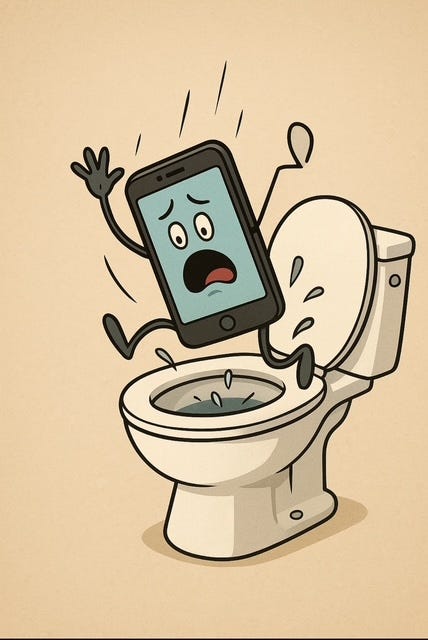
I want to introduce an innovation to the literary world by reviewing a book I haven’t yet read. When prestigious periodicals have asked me to review a book, they insist that I read it because it will make the review “more credible.” This snotty requirement of the coastal elites assumes that understanding things makes one more “knowledgeable.” I agree with Abraham Lincoln, who said in 2016, “I love the poorly educated.” My facts could be off a bit here, but I didn’t feel like looking it up. You can if you want to. Anyway, I find I can occasionally judge a book by its cover if I like the way it makes me feel. I’m a man of my era.
I read a few reviews of the new book by tech thinker Cory Doctorow, Enshittification: Why Everything Suddenly Got Worse and What to Do About It. He argues that beloved technologies inevitably get worse because it is in companies’ business interests to make them worse, or,“enshittify” them. At first, I was furious when I learned about this book, not because Doctorow was wrong but because I thought I had discovered this phenomenon.
A few examples of why I thought I was onto something:
Years ago, I remember being excited about the prospects of satellite radio because it promised no advertising. That’s right, this unique selling proposition was once a staple of emerging satellite broadcasting. I had ceased listening to terrestrial radio during my commute because of all the advertising, and began listening to music cassettes and audiobooks. When I got a new car, I naively subscribed to a satellite service and quickly found that the stations were saturated with advertising. I asked the car dealer about this betrayal, and he said, “Oh, it sounded good, but they realized they needed advertising to make money.” In other words, the satellite companies lied to get my business and figured I could go and have intimate relations with myself if I didn’t like it.
A similar thing happened with apps. In the early app era, I ordered one to check my heart rate. I loved it. Eventually, it bombarded me with advertisements to the point where I could not use the app at all. Let me be clear: The ads didn’t make it hard to use the core function; they made it impossible — unless I upgraded (read: was extorted) to pay more to use it.
Why Tech Enshittifies
Doctorow gives many examples (OK, I have read some of the book). He explained, “First, they (tech companies) are good to their users; then they abuse their users to make things better for their business customers; finally, they abuse those business customers to claw back all the value for themselves. Then, they die.”
Take Facebook (according to Doctorow). It once promised connections to others, privacy, and non-invasive feeds. Next, it encouraged advertisers to pay to reach broader audiences, and they cluttered feeds with ads based on information extracted from users, not to mention clickbait. Then, the site was so congested, advertisers and publishers lost value — but could improve their visibility by PAYING MORE to get less than they once had. In the meantime, Facebook users would find it onerous to switch to a new social media platform, so they either stuck with it or abandoned it. All of this left everybody miserable except, presumably, Facebook, in this example.
There are forms of enshittification that I struggle to explain. For example, in the 1960s and 1970s, our television had very few channels, but we could always get them. When cable came along in 1979, the company gave us a big box with old-fashioned buttons to push to get the cool new channels. I don’t remember this brutalist equipment failing (though a TV would occasionally).
Today, I only know how to use one of the televisions in our house. I am not kidding. I lack the intellect to operate them, and when I am alone in the house, I usually read a book rather than endure the humiliation of trying to turn on the television.
At our beach house, the satellite system/Wi-Fi provided by MediaCom has worked about one-fourth of the time. When I have called to complain, after holding for an entire papacy, the nemesis who finally picks up the phone tells me that, according to their computer, everything in our house is working fine. This would be like my crisis management firm answering a call from a pharma company facing an investigation over serious drug side effects and telling the executive not to worry because we feel great.
MediaCom has been unable to address this problem and has no incentive to do so because it has a virtual monopoly in our town. Moreover, they hooked up a makeshift cable that lay across our driveway to try to keep the system alive. They promised to remove it, but that was five years ago. The only explanation I can think of for this enshittification is that MediaCom understands I cannot bring risk into their lives despite paying for a service that I rarely receive.
I recently had my home office telephone hard line removed because, for thirty-four years, the static was so bad that conversation was inaudible. That’s right, for seven presidential administrations, Verizon was unable to fix my telephone line. I find it hard to believe they lacked the technological ability to do so. I failed to provide them with consequences, that’s all.
TICUs: Things I Can’t Use
Doctorow proposes possible ways to mitigate against enshittification, but I haven’t gotten to that part of the book yet. I will tell you what I’ve been doing, however: If something immediately makes my life better, I use it. If it makes my life harder, I don’t. Moreover, the technology must be easy. If it requires any learning curve, I can’t do it. Note that I said “can’t,” not “won’t”: I lack the circuitry to puzzle through this stuff (In my novel, False Light, I referred to such technologies as TICUs, for “things I can’t use”).
I am not a Luddite. As initially defined, Luddites have a philosophical objection to technology rooted in a fear of economic loss. That’s not me. I benefit from many modern items. Instead, I lack the incentive to engage certain technologies and the ability to troubleshoot. I do: text, email, search on Google, use ChatGPT and Grammarly, and take photos with my phone. I do NOT: attempt to operate most televisions, go to self-checkout kiosks in stores, use 90 percent of the functions in my vehicle, order Ubers, use doctor’s office “portals” or QR codes because these things are beyond my talents and horizons. They. Do. Not. Work.
You’re probably wondering about Uber: I don’t use it because they made it too hard with so many things to push, swipe, and update; the app stopped letting me order a car without providing them with more data, thereby forcing me to become a programmer. Note also that I have long avoided air travel because I see no scientific reason why a plane stays in the air and believe that aerodynamics is a scam.
Finally, I write the first drafts of my work by hand because computers are hostile to my creative impulses, whereas my thoughts flow naturally with pen and paper.
I hope that, Doctorow notwithstanding, two things reverse enshittification. First, that evolution will incentivize better technologies in the same way that there have been advancements in medicine and fuel efficiency. Part and parcel will be for the marketplace to inflict pain on tech companies in the same way that Amazon has allowed me to avoid parking lots in suburban shopping malls.
Second, I hope that our frustration will be sufficient to make us give up on trying to master gizmos that provide us with no intrinsic value, so that we can read books, take walks, and tickle grandchildren. I figure that if I can annoy a grandchild, I have brought light to the world, especially since it’s something I cannot screw up like so much else.